Showing posts with label Portuguese. Show all posts

17 July 2014

TL e a CPLP não deviam acolher um ditador corrupto

Líderes dos países de língua portuguesa reúnem-se em Dili para a X Cimeira de Chefes de Estado e de Governo da Comunidade dos Países de Língua Portuguesa (CPLP). Um dos items mais importantes e mais controversos da sua agenda será a adesão da Guiné-Equatorial como membro permanente da CPLP.

Em Dili tem-se discutido muito as preparações para as visitas destes VIP – construção urgente generalizada e alto volume de despesa – mas a La'o Hamutuk propõe que se preste mais atenção ao que se vai passar na própria Cimeira. Ontem a La'o Hamutuk e muitos outros timorenses preocupados com os Direitos Humanos enviaram uma Carta Aberta (original em tetum ou English) ao Presidente da República Taur Matan Ruak e a outros dirigentes timorenses, lembrando-os de que “muitas pessoas não concordam com esta adesão da Guiné-Equatorial, uma nação não-falante de português” e pedindo-lhes que a Cimeira “não ratifique esta adesão ou que, no mínimo, a torne condicionada à existência de melhorias significativas na área dos direitos humanos e da redução da corrupção.”

1995: protestos contra a visita de Suharto à cidade de Nova Iorque.
Durante a ocupação de Timor-Leste pela ditadura brutal e corrupta de Suharto, amigos em todo o mundo protestavam sempre que Suharto visitava os seus países. Em conjunto com os líderes de muitos países de língua portuguesa, fizeram-se campanhas para isolar o regime indonésio da legitimidade internacional. Acreditamos que o povo da Guiné-Equatorial tem direito ao mesmo tipo de apoio na sua luta contra o regime que os tem governado nos últimos 35 anos.

A La'o Hamutuk colocou uma página no seu site com a nossa Carta Aberta e outros materiais de referência. As principais razões pelas quais pensamos que Timor-Leste e a CPLP não deveriam acolher este ditador no nosso país e na nossa comunidade são as seguintes:
  • Não existência de democracia, violação permanente de direitos humanos, incluindo mortes
  • Limitação da liberdade de imprensa e da possibilidade de os cidadãos expressarem as suas opiniões
  • Pobreza generalizada num país que é um dos países africanos com maior riqueza petrolífera
  • Inexistência de transparência sobre finanças governamentais
  • Um dos regimes mais corruptos do mundo.
A Guiné-Equatorial tem menos população, mais petróleo e maior pobreza do que Timor-Leste, e é um caso exemplar de “maldição dos recursos”. Ainda assim, o ditador Teodoro Obiang vai trazer com ele 80 pessoas para a Cimeira da CPLP. Foi-nos explicado que o seu avião é grande demais para poder aterrar em Dili, razão pela qual terá de alugar dois aviões mais pequenos em Singapura.
A Constituição de Timor-Leste determina que a RDTL estenderá a sua solidariedade a todos os povos do mundo na sua luta pela libertação nacional mas os Estatutos da CPLP dizem que um Estado membro não pode “interferir” nos assuntos internos de outros membros. Se Timor-Leste e a CPLP aceitarem a Guiné-Equatorial como membro, estarão a abandonar o seu compromisso com os direitos humanos do povo deste país.


16 October 2013

HASATIL statement for World Food Day

HAMETIN AGRIKULTURA SUSTENTAVEL TIMOR-LOROSAE

This statement is available as PDF in English, Tetum, Portuguese and Bahasa Indonesia.

Today, October 16th, 2013, many nations around the world celebrate World Food Day. Unfortunately, in this world we're living in, a lot of poor people are hungry because they do not have access to food, while at the same time many wealthy people suffer from health conditions due to excessive food consumption or imbalanced food diet. Globally, there is enough food for everyone to consume, but it is unequally distributed.

The official theme of this year’s World Food Day is: “Sustainable Food Systems for Food Security and Nutrition.” This is an opportunity for us to question about:
  •  Non-sustainable food systems that produce poor quality food with low nutritional values, like the processed industrial products full of preservatives, salt, sugar (e.g. in instant meals) and industry-related pollutants.
  • Non-sustainable food systems that damage the environment by using a lot of energy and natural resources to produce industrial food, and causing many forms of pollution like plastics, cans and other materials used for wrappings.
  • Non-sustainable food systems that create social injustice as they do not give value to the work of the farmers but instead generate huge benefits for the agro-chimical industries.
  • Non-sustainable food systems that have altered our food habits, traditional cooking and culture to eat in season, and have lead us to consume a limited variety of food and to prefer unhealthy instant meals.
  • Non-sustainable food systems that promote an industrial agriculture model based on mechanization, the excessive use of pesticides, chemical fertilizers and water, as well as standardized "high yielding" seeds produced by laboratories at the expense of the variety of local seeds that are actually more adaptable. The result is a massive loss of biodiversity.
The HASATIL Network, a network of NGOs working to strengthen sustainable agriculture in Timor-Leste, promotes the concept of food sovereignty. Timor-Leste is a small island with its own food products that need to be promoted so that we do not depend too much on food imports. We must develop the agriculture sector sustainably through food diversification and the adoption of an organic and integrated agriculture model, like agro-ecology and permaculture, which follow the natural ecological cycles.

The message to the farmers:

Thank you for your contribution and the great efforts you make to produce good and healthy food. We should not abandon our local original food crops including the wild ones that saved us during our long struggle for independence. We must promote food diversification in our farms, to improve child nutrition and avoid dependence on a few crop species only.

The message to all of us consumers:

We must use our purchasing power to buy products which are healthy, which strengthen the domestic economy through the purchase of local products from small-scale farmers and which are not harmful to the environment. We must give higher value to our local products than to the imported ones and change this mentality consisting in considering eating rice as the only parameter that measures whether one has had his/her meal or not. There is a variety of food products much more nutritious than rice (carbohydrate), such as vegetables, fruits, beans, cassava, meat, fish, etc. We must not eat with the only objective to be full; we must know the nutritional value of the food we eat.

Our message to the Timor-Leste Government, which has an important role in guaranteeing that development benefit all Timorese people, of the current and future generations:

Food security must not be viewed from the quantitative aspect only. Every year we import huge amount of foods (especially rice) but our level of malnutrition remains high. We consume much more rice and much less fish than other countries . The Government should address the malnutrition issue from a qualitative aspect, and focus on food diversification and education about nutrition. Priority should be given to the development of the livestock and poultry sectors, fisheries, forestry rehabilitation and protection and rural infrastructure.

The Government should take measures to reduce food imports and regulate the import of chemical products that have bad effects both on health and the environment. The productive sector and small-scale sustainable co-operatives should be developed to substitute our economy that is heavily dependent on petroleum revenues.

The Government should promote a sustainable agriculture model that doesn’t depend on expensive inputs, benefit small farmers and contribute to nature enhancement like agro-ecology and permaculture.

At the international level, the UN Special Rapporteur on the Right to Food Sr. Olivier de Schutter has already shown that the future of agriculture is agro-ecology . Thus, we encourage Timor-Leste Government to build a sustainable food system for our nation, to guarantee our food sovereignty.

HASATIL Advocacy Team and Secretariat

  • La’o Hamutuk Institute
  • HAK Association
  • Haburas Foundation
  • Fokupers
  • Caritas Baucau
  • Kdadalak Sulimutuk Insitute (KSI)
  • Haburas Moris Organization (OHM-Maliana)

24 May 2013

Presidential concerns about the State Budget

At the end of February, President of the Republic Taur Matan Ruak promulgated the RDTL General State Budget for 2013. At the same time, the President wrote a letter and memorandum to Members of Parliament, expressing his concerns, including about budget execution rates, expensive speculative projects, inflation, low allocation for human development, the Tasi Mane project and unemployment. Many of his suggestions address the same issues as La'o Hamutuk's submission to Parliament.

Although the President's office did not make his letter public, La'o Hamutuk obtained it from Parliament and is making it available in Portuguese and our unofficial English translation, which follows (links and graphics added by La'o Hamutuk).

President of the Republic
GENERAL STATE BUDGET (GSB) FOR 2013
General Notes and Recommendations

1. The President notes that the rate of execution of the State Budget for 2012 will have been about 70%, and this corresponds to spending of approximately USD $1,200 million. In the GSB for 2013, the Ad-hoc Committee submitted an alternative proposal (to the initial proposal of $1,797.5 million) of $1,647 million. This proposal was approved with 64 votes in favor and 1 abstention.

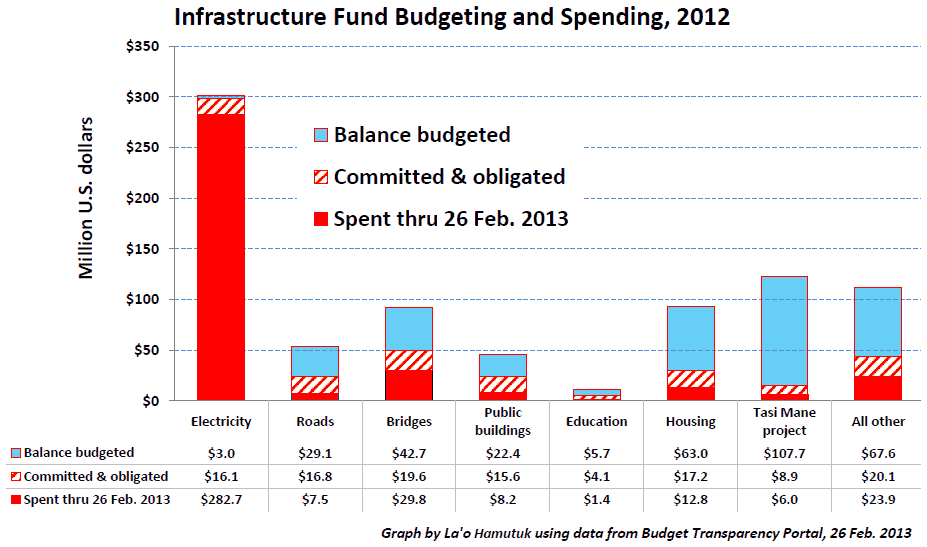
2. Of the total value of the Infrastructure Fund planned for 2012, only 49% of the funds were spent. If you exclude the funds for the electrification project of the country, the rate of execution of the Infrastructure Fund in 2012 was significantly lower: 29%.

3. The total expenditures of the 2013 State Budget are $1,647.519 million, which was reduced by $155 million (-8.3%) from the Government’s initial proposal. This reduction is mainly achieved through reduced expenditure on Development Capital / Infrastructure (-$135 million) and a decrease of $20 million in spending on goods and services. The reduction in goods and services is due to the fact that this budget will be approved 2 months later than what the law determines (1 January 2013).

4. “The $1,501.219 million fiscal deficit of the state budget”, “is financed with $787 million from the Petroleum Fund, $43.6 million through the use of public credit” (soft loans from international donors), “$409.8 million in the balance carried forward from Special Funds” (mainly the Infrastructure Fund), and “$260.8 million from the balance in the Treasury Account.”

5. The President welcomes the reduction in the amount of the state budget compared with last year. However, taking into account the history of low rates of execution,  the President draws attention to the urgent need to complete the execution of this budget. There appears to have been a high tone of optimism in the definition of expenses to carry out, especially for projects that end up not being executed.

6. The President notes that the relative abundance of financial resources has given rise to speculative projects with inflated prices with significantly prejudice to the public interest.

7. The President welcomes the statements made by Members of Parliament as well as the affirmation of the Prime Minister, with respect to the functions of supervision and monitoring of project execution through quarterly meetings to take place between the Parliamentary Standing Committees and the respective members of the Government. The President believes that these actions will better protect the national interest.

8. Average annual rates of inflation reached 13.5% in 2011 and 11.8% in 2012. The President hopes that this GSB can contribute to reducing  inflation that the country has suffered during the last two years. These values greatly reduce the purchasing power of civil servants, mainly those who earn lower wages, and especially citizens with low incomes.

9. The President notes that, on the one hand, in the structure of expenditure in this State Budget, 46% is allocated to the construction of infrastructure, prioritizing spending on electrification of the country, road reconstruction and the Tasi Mane project. On the other hand, there is much less spending in key areas of human development -- education receives only 5.6%, health receives 3.7% -- and agriculture, which involves about 80% of the population, gets only 1.5% of the total budget.

10. The President welcomes the special allocation for Oecusse. However, he regrets the lack of a budget for the “planning” of Dili, the capital of the Republic which welcomes the diplomatic community and is the main gateway to the Country.

11. Regarding the Tasi Mane project on the South Coast, the President understands the reasons that appear to justify not having changed the intended amount. However, he would like to see a public explanation of the reasons for allocating these funds, in particular when compared with other expenses with obvious social utility. For example, two kilometers of highway are likely to cost $20 million and the budget allocated to agriculture is about $25 million.

12. The President was informed that losses caused by illegal fishing amount to more than $200 million per year. The President regrets not finding an adequate response to this problem in this budget, which continues to affect the potential for national fishing.

13. With regard to domestic revenues, the President hopes that the efforts of the Executive for better tax administration and collection of taxes, duties and other revenues will be effective. The President intends to urge firm measures to combat tax evasion and capital flight, which will allow for greater prudence in using money from the Petroleum Fund.

14. Responding to unemployment is an unavoidable necessity. The President hopes that this GSB can generate more permanent jobs, contributing to a significant reduction in poverty that affects more than 50% of households in the interior of our Country. The President also hopes that this budget will contribute to a tangible decrease in the asymmetry between the capital Dili and other districts.

07 July 2011

Strategic Development Plan & proposed laws online

La'o Hamutuk has scanned and posted the Portuguese-language, 234-page proposed Strategic Development Plan that the Government presented to Parliament this week.  The Prime Minister has urged Parliament to approve it on Monday, 11 July, before the Development Partners meeting.

For the SDP documents, and more information, click this link.

Update: On Thursday afternoon, the SDP was posted to the Government portal website in English (16 MB) and Portuguese (4 MB).
 
On 11 July, as Parliament began debating the Plan, La'o Hamutuk circulated our preliminary analysis.

Earlier this week, Parliament received two other important legislative proposals which were passed by the Council of Ministers in June, and we have posted the Portuguese texts and explanatory memoranda, and translated them into English. Scroll up from the links below for background, analysis and other documents:
Revision to the Petroleum Fund Law

Regime for taking on external debt

09 February 2010

Council of Ministers Legislative Plan Feb-July 2010

On 9 February 2010, the Secretary of State for the Council of Ministers issued a press release in Tetum and Portuguese with the Legislative Action Plan for the next six months. La'o Hamutuk, with the help a computer, has translated it into English. Laws already approved by the CoM but pending before Parliament (such as the Domestic Violence Law) are not included in this list.

SECRETARY OF STATE COUNCIL OF MINISTERS
PRESS RELEASE


The Legislative Action Plan for the First Half of 2010 was designed after consultations and joint work between the various Ministries and State Departments, and with the lists based legislative priorities of each sector.

The Government will therefore examine and decide on various pieces of legislation and regulations takes action to ensure the normal development of the country.

The Legislative Action Plan reflects the desire of the IV Constitutional Government of Timor-Leste coordinate efforts to provide the necessary regulatory tools that allow provide a further progress to the nation.

Thus, documents which the Council of Ministers intends to review by July this year are:

  • Draft law amending the Organic Law of the Presidency of the Republic;
  • Decree-Law Organic Law of the Ministry of Infrastructure;
  • Decree-Law establishing the Committee of Procurement;
  • Government Resolution on the Family Health Registry;
  • Decree-Law on Access to Visa on arrival and in transit in Timor-Leste;
  • Decree-Law that approves the Environmental Licensing System;
  • Resolution of the Government approving the Strategic Plan for the Justice Sector;
  • Government Resolution establishing a Standing Committee on Data Verification (Combatants for National Liberation);
  • Government Resolution on the Joint feasibility Study of the LNG project in Timor-Leste;
  • Draft law approving the Labor Code;  (not in Tetum version)
  • Decree-Law that approves the Organic Statute of UNTL;
  • Government Resolution approving the National Strategy for Employment;
  • Government Resolution approving the Policy on Professional Training;
  • Resolution of the Government establishing a working group to establish a Social Security System in Timor-Leste;
  • Decree-Law amending the Organic Law of the Ministry of State Administration;
  • Decree-Law that approves the Legal Framework of Administration and Management System of Basic Education;
  • Resolution of the Government on the delivery of motor vehicles to Chefes Sucos, permanently, at the end of their mandates;
  • Government Resolution approving the Strategic Plan for Development of Youth and Sports;
  • Government Resolution adopting the National Sports Policy.
  • Proposed Law on the Special Regime for the Definition of Ownership of Real Estate – Land Law
  • Proposed Law on Expropriation;
  • Proposed Law on Real Estate Financial Fund;
  • Decree-Law amending the Regulation on Discipline of the PNTL;
  • Decree-Law on the Statute of the Labor Inspectorate;
  • Decree-Law on labor conciliation, mediation and arbitration;
  • Resolution of the Government approving the National Security Policy;
  • Draft law approving the system of Forest Management;
  • Decree-Law amending the Organic Law of the Ministry of Health;
  • Decree-Law that approves the Special Career regime for Health Professionals;
  • Decree-Law on the Statute of the Teaching Career of Higher Education;
  • Draft law amending the Statute of the Public Prosecutor;
  • Decree-Law establishing the Municipal Development Planning Commission;
  • Decree-Law that approves the Municipal Development Plan;
  • Decree approving the Municipal Investment Program;
  • Government Resolution adopting the National Policy for the Media;
  • Government Resolution adopting the Telecommunications Policy;
  • Proposed Law of Private Investment;
  • Proposed law amending the Petroleum Fund Law;
  • Decree-Law on the Statute of Prison Guards;
  • Decree approving the Fees for Register and Notaries;
  • Decree-Law that approves the Code for Court Costs.
  • Decree-Law that regulates access to medical treatment outside the country;
  • Decree-Law establishing the National Oil Company;
  • Decree-Law establishing the Institute of Petroleum and Geology;
  • Resolution of the Government approving the Strategic Plan for the Health Sector until 2030;
  • Decree-Law amending the Organic Law of the Ministry of Foreign Affairs;
  • Decree-Law on the Statute of Diplomatic Service;
  • Decree-Law on the Statute of Diplomatic Remuneration;
  • Decree-Law on registration of vehicles with diplomatic status;
  • Decree-Law that approves the Budgeting and Financial Management of Municipalities;
  • Decree-Law that approves the Municipal Procurement regime;
  • Proposed Law of the Census;
  • Proposed law on voter registration and updating of databases on national territory and abroad;
  • Decree-Law amending the Organic Law of the Ministry of Education; iv) Law on the Statute of the Teaching Career;
  • Decree approving the organization of the Institute of Training and Training of Teachers;
  • Proposed law approving the budget rectification;
  • Proposed Law on Issuance and Managing of Public Debt;
  • Decree-Law amending the Organic Law of the Ministry of Finance;
  • Decree-Law creating the National Development Bank.
  • Proposed law approving the Legal Regime of Tax Offenses and Penalties;
  • Decree-Law on Tax Procedure;
  • Decree-Law that approves the Special Career regime for Staff of the Ministry of Finance;
  • Decree-Law amending the Organic Law of the State Secretariat for Security;
  • Decree-Law amending the Organic Law of the PNTL;
  • Decree-Law on the Statute of PNTL staff;
  • Decree on teacher training;
  • Decree-Law that approves the Legal Framework for the Evaluation of Higher Education and the establishment of the INAAES;
  • Decree-Law that approves the Organic Law of the State Secretariat of Natural Resources;
  • Decree-Law on "downstream” activities;
  • Draft law amending the Immigration and Asylum Law;
  • Decree-Law establishing the rules for granting subsidies to mothers;
  • Decree-Law establishing the rules of access to housing;
  • Decree-Law regulating the provision of assistance to communities in the event of disasters;
  • Decree approving the scheme of relations between municipalities and sucos;
  • Decree approving the Strategy on Capacity Development in the Decentralization Framework;
  • Decree-Law regulating the administrative procedure leading to the loss of quality of soldiers and veterans;
  • Resolution of the Government that renames 4 members of the Committee on Tribute, Registration and Supervision of Resources;  (for veterans)
  • Resolution of the Government regulating the demobilization of former FALINTIL combatants.
  • Draft Act establishing the National Board of Health;
  • Decree-Law that defines the Rules of Continence and Police Honors;
  • Decree-Law that defines the Uniform Rules of Coats;
  • Decree-Law on the Regulation of the Border Management System;
  • Decree-Law on the Statute of the Teaching Career of Higher Education;
  • Proposal for Mining Activities Law;
  • Proposal for Law on the Environment;
  • Decree-Law establishing the National Authority for the Environment;
  • Resolution of the Government approving the creation of TimorLNG;
  • Proposal of the Basic Law on Renewable Energy;
  • Decree-Law establishing the Regulatory Authority for Renewable Energy;
  • Resolution of the Government approving the National Energy Policy;
  • Government Resolution approving the Plan of Rural Electrification for Families in remote areas;
  • Proposal of the Basic Law of Civil Protection;
  • Decree-Law on the Statute of the Personnel Bureau for Firefighters;
  • Draft Act on the provision of food, and Decree-Law on the Support Centers for victims of domestic violence (these two texts are dependent on approval of the Law on Domestic Violence);
  • Decree-Law that approves the Regulation of the Public and Private Domain of the State; Decree-Law that regulates the Cadastral Commission, and Decree-Law that approves the Code of Land Registry (these three are dependent on prior approval of the Land Law);
  • Draft law on the exercise of parental responsibility; draft law on adoption; Proposed Law on guardianship of minors, and Decree-Law that approves the Code of Civil Registration (these four are dependent on approval of the Civil Code);
Remember that this Action Plan represents the legislative orientation and work methodology that the Government wishes to follow, with the prospect of improvements in accordance with experience, and is therefore subject to change as necessary.

(Portuguese original follows below)