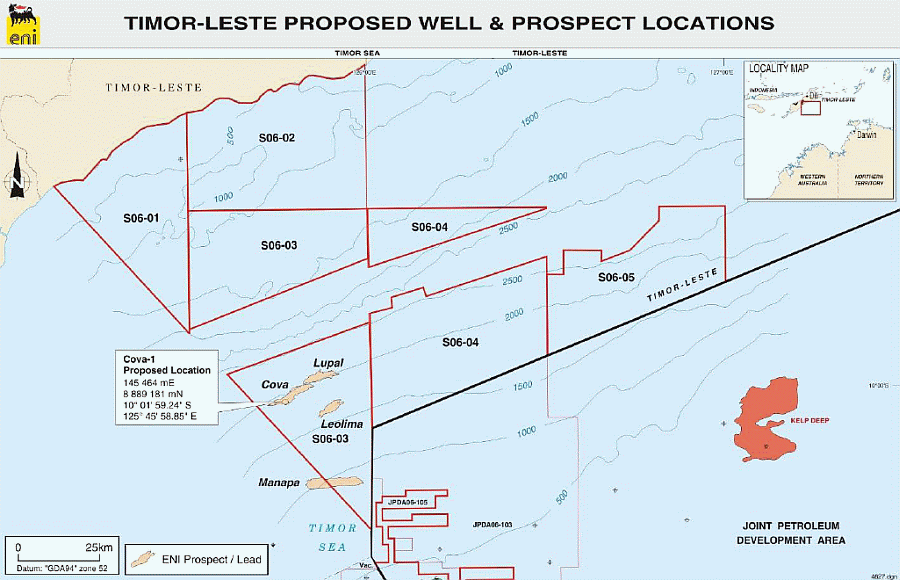
The huge Italian oil company Eni operates several contracts for oil exploration in Timor-Leste's Exclusive Area and in the Joint Petroleum Development Area. Even before receiving approval for drilling the Cova-1 well in S06-03 of the TLEA, this month, Eni requested permission to drill up to three more wells in this area. La'o Hamutuk's submission urges a more deliberative regulatory process, and we encourage the National Petroleum Authority (ANP) to consult the public on health and safety issues (including spills and accidents), in addition to the consultation being done by the RDTL Directorate for the Environment on environmental effects of normal operation. Eni and DNMA have scheduled a consultation meeting for all interested parties on 27 October at 10:00 am at Eni's Dili office. Please RSVP in advance to Jose Pires of Eni (730 5079, jose.pires@enitimorleste.tl).
Eni just announced another public consultation, on the final EIS for the Kitan project. Click here for La'o Hamutuk's page on this project (including our April 2010 submission), and here for Eni's page with the relevant documents. Eni invites comments until 19 November 2010.
Kitan will be the first oil or gas project to start production since Timor-Leste became independent. Although it will provide only about 3% as much revenue as Bayu-Undan, it is an important test and learning experience for regulators, companies and civil society as this new nation enters into perilous waters.
18 October 2010
13 October 2010
Faktu Ekonomiku Bázika
Semana hirak tan, Konsellu Ministru sei propoin Orsamentu Jerál Estadu tinan 2011, ne'ebé dala ruma to’o dollar biliaun ida, ba Parlamentu Nasionál. Iha preparasaun ba diskusaun ne'e, La'o Hamutuk halo tiha ona gráfiku tolu kona-ba realidade fundamentál ekonomia nian iha Timor-Leste. Bainhira faktus sira be hadalan ne’e bele komprende ba, orsamentu tinan oin mai ne’e hare ba atu sai hanesan la sustentavel liu tan no la prudente kompara ba orsamentu rektifikativu tinan-klaran nian ne’ebe pasa ona iha fulan haat liu ba. Fekit ba kada gráfiku ida-idak hodi haree ho dimensaun boot liu tan..
Dependénsia ba importasaun sira ne'e la saudável no la sustentável. Ohin loron, agrikultura no indústria iha Timor-Leste la bele fornese ita nia nesesidade sira lor-loron. Gráfiku iha sorin loos ne'e bazeia ba estatístika ofisiál; realidade, importasaun provavelmente aas liu porsentu 50% husi tokon $283 iha relatoriu tinan 2009, bainhira esportasaun menus husi tokon $10. Karik ita la bele prodús ita nia aihan rasik, be, sementi no nesesidade bázika sira seluk, oinsá ita sei bele moris bainhira ita la iha ona osan husi mina-rai nian hodi selu ba sosa sasán sira ne`ebe mai husi tasi-balun?
Gastu estadu nian sa'e makaas liu duke ekonomia doméstika. Karik ita hasai tiha despeza governu nian, ekonomia naun-petroleu Timor-Leste nian stagnadu no dala ruma tun ka diminui. Ho rendimentu governu nian maizumenus 95% mai husi mina-rai no gas, ekonomia saidá mak ita sei iha hafoin mina-rai ho gás ne’e uza hotu ona?
Ita nia rezerva petróleu ki'ik no limitadu. Maske ita susesu hodi lori kadoras gás Sunrise nian mai Timor-Leste, no mesmu karik esplorasaun foin daudauk ne'e hetan tan depózitu foun mina-rai ka gás nian hodi dezenvolve, ita nia osan totál mina-rai nian hare ba dalaruma menus husi biliaun $50. Karik ita gasta hotu bainhira sira tama mai, rata-rata ba ita nia populasaun nian no tinan 40 produsaun nian, rata-rata ida ne'e besik $1.65 ba kada sidadaun ba loron ida, ka menus dala rua husi Orsamentu Estadu 2010. Karik osan mina nian hasai hotu ba projetu infraestrutura ne'ebé konsidera la iha kualidade, importasaun ne'ebé lolos ita bele evita, ka fahe ba grupu perturbador, ita nia povo barak mak sei la hetan benefisiu.
Dependénsia ba importasaun sira ne'e la saudável no la sustentável. Ohin loron, agrikultura no indústria iha Timor-Leste la bele fornese ita nia nesesidade sira lor-loron. Gráfiku iha sorin loos ne'e bazeia ba estatístika ofisiál; realidade, importasaun provavelmente aas liu porsentu 50% husi tokon $283 iha relatoriu tinan 2009, bainhira esportasaun menus husi tokon $10. Karik ita la bele prodús ita nia aihan rasik, be, sementi no nesesidade bázika sira seluk, oinsá ita sei bele moris bainhira ita la iha ona osan husi mina-rai nian hodi selu ba sosa sasán sira ne`ebe mai husi tasi-balun?Gastu estadu nian sa'e makaas liu duke ekonomia doméstika. Karik ita hasai tiha despeza governu nian, ekonomia naun-petroleu Timor-Leste nian stagnadu no dala ruma tun ka diminui. Ho rendimentu governu nian maizumenus 95% mai husi mina-rai no gas, ekonomia saidá mak ita sei iha hafoin mina-rai ho gás ne’e uza hotu ona?
Ita nia rezerva petróleu ki'ik no limitadu. Maske ita susesu hodi lori kadoras gás Sunrise nian mai Timor-Leste, no mesmu karik esplorasaun foin daudauk ne'e hetan tan depózitu foun mina-rai ka gás nian hodi dezenvolve, ita nia osan totál mina-rai nian hare ba dalaruma menus husi biliaun $50. Karik ita gasta hotu bainhira sira tama mai, rata-rata ba ita nia populasaun nian no tinan 40 produsaun nian, rata-rata ida ne'e besik $1.65 ba kada sidadaun ba loron ida, ka menus dala rua husi Orsamentu Estadu 2010. Karik osan mina nian hasai hotu ba projetu infraestrutura ne'ebé konsidera la iha kualidade, importasaun ne'ebé lolos ita bele evita, ka fahe ba grupu perturbador, ita nia povo barak mak sei la hetan benefisiu.
Labels:
Tetum
Timor-Leste Basic Economics
In a few weeks, the Council of Ministers will propose the 2011 General State Budget, which may be close to a billion dollars, to the National Parliament. In preparation for that discussion, La'o Hamutuk has made three graphs of fundamental economic realities in Timor-Leste. Unless these underlying facts are understood, next year's budget is likely to be even more unsustainable and unwise than the mid-year budget adjustment passed four months ago. Click on each graph to see it larger.
Dependency on imports is unhealthy and unsustainable. Today, agriculture and industry in Timor-Leste cannot provide for our daily needs. The graph at right is based on official statistics; in reality, imports are probably 50% higher than the $283 million reported for 2009, while exports are less than $10 million. If we cannot produce our own food, water, cement, and other basic necessities, how will we survive when we have no oil money to pay for buying them from overseas?
Government spending is growing faster than the domestic economy. If you subtract out government expenditures, Timor-Leste's non-oil economy is stagnant and probably shrinking. With about 95% of government revenues coming from oil and gas, what economy will we have after the oil and gas is used up?
Our petroleum reserves are small and finite. Even if we succeed in bringing the Sunrise gas pipeline to Timor-Leste, and even if current exploration finds new oil or gas deposits to develop, our total oil revenues are likely to be less than $50 billion. If we spend them all as they came in, averaged over our population and 40 years of production, this averages about $1.65 per citizen per day, or less than twice the 2010 State Budget. If the oil revenues are squandered on ill-considered infrastructure projects, avoidable imports, or handouts to troublesome groups, most of our people will not benefit.
Dependency on imports is unhealthy and unsustainable. Today, agriculture and industry in Timor-Leste cannot provide for our daily needs. The graph at right is based on official statistics; in reality, imports are probably 50% higher than the $283 million reported for 2009, while exports are less than $10 million. If we cannot produce our own food, water, cement, and other basic necessities, how will we survive when we have no oil money to pay for buying them from overseas?Government spending is growing faster than the domestic economy. If you subtract out government expenditures, Timor-Leste's non-oil economy is stagnant and probably shrinking. With about 95% of government revenues coming from oil and gas, what economy will we have after the oil and gas is used up?
Our petroleum reserves are small and finite. Even if we succeed in bringing the Sunrise gas pipeline to Timor-Leste, and even if current exploration finds new oil or gas deposits to develop, our total oil revenues are likely to be less than $50 billion. If we spend them all as they came in, averaged over our population and 40 years of production, this averages about $1.65 per citizen per day, or less than twice the 2010 State Budget. If the oil revenues are squandered on ill-considered infrastructure projects, avoidable imports, or handouts to troublesome groups, most of our people will not benefit.
Labels:
English
08 October 2010
Pajina web foun kona-ba Kodigu Sivil
La’o Hamutuk foin lansa pajina web foun ne’ebe inklui kopia ba esbosu Kodigu Sivíl, submisaun no rekursus seluk iha lingua Ingles no Tetum.
Semana kotuk Komisaun A Parlamentu Nasional simu submisaun kona-ba esbosu Kodigu Sivil. Kodigu Sivil mak baze ba lei sivíl iha Timor-Leste, no iha impaktu ba ema Timor-oan husi moris to’o mate. Esbosu Kodigu Sivil hatete regras kona-ba kazamentu, adopsaun, paternidade, alimonia, divorsiú no warisan/eransa. Esbosu mos kria regras kona-ba direitu ba ema ne’ebe arenda rai no direitu uma-nain, akordus aluga rai, oinsa okupasaun legal, konpensasaun, hipoteka no direitu ba bee. Esbosu Kodigu Sivil iha pajina liu 500, no iha “kopia pas” husi Kodigu Sivil Portugal-nian, Kodigu Sivil ne’e la konsidera pratika lokal no kustume iha Timor-Leste.
Esbosu Kodigu Sivil mak lei primeiru husi pakote esbosu lei kona-ba propriedade ne’ebe Komisaun A atu konsidera. (Planu uluk atu haree ba esbosu Lei ba Rai, maibe Komisaun deside hafoin Kodigu Sivil). La’o Hamutuk nia submisaun hato’o preokupasaun balun katak esbosu Kodigu Sivil sai ameasa ba ema ne’ebe vulneravel nia direitu ba rai, direitu ba uma no direitu ba bee. La’o Hamutuk ezizi ba Parlamentu atu hein to’o governu Konsultasaun Nasional kona-ba Rai molok aprova lei ne’ebe liga ba direitu ba propriedade.
Ami prontu atu simu dokumentu no analiza tan husi parte hotu.
Semana kotuk Komisaun A Parlamentu Nasional simu submisaun kona-ba esbosu Kodigu Sivil. Kodigu Sivil mak baze ba lei sivíl iha Timor-Leste, no iha impaktu ba ema Timor-oan husi moris to’o mate. Esbosu Kodigu Sivil hatete regras kona-ba kazamentu, adopsaun, paternidade, alimonia, divorsiú no warisan/eransa. Esbosu mos kria regras kona-ba direitu ba ema ne’ebe arenda rai no direitu uma-nain, akordus aluga rai, oinsa okupasaun legal, konpensasaun, hipoteka no direitu ba bee. Esbosu Kodigu Sivil iha pajina liu 500, no iha “kopia pas” husi Kodigu Sivil Portugal-nian, Kodigu Sivil ne’e la konsidera pratika lokal no kustume iha Timor-Leste.
Esbosu Kodigu Sivil mak lei primeiru husi pakote esbosu lei kona-ba propriedade ne’ebe Komisaun A atu konsidera. (Planu uluk atu haree ba esbosu Lei ba Rai, maibe Komisaun deside hafoin Kodigu Sivil). La’o Hamutuk nia submisaun hato’o preokupasaun balun katak esbosu Kodigu Sivil sai ameasa ba ema ne’ebe vulneravel nia direitu ba rai, direitu ba uma no direitu ba bee. La’o Hamutuk ezizi ba Parlamentu atu hein to’o governu Konsultasaun Nasional kona-ba Rai molok aprova lei ne’ebe liga ba direitu ba propriedade.
Ami prontu atu simu dokumentu no analiza tan husi parte hotu.
Labels:
Tetum
New LH web page on the draft Civil Code
La'o Hamutuk has launched a new web page which includes copies of the draft Civil Code, submissions and other resources in English and Tetum.
Last week Parliamentary Committee A received submissions on the draft Civil Code. The Civil Code is the basis of civil law in Timor-Leste and will affect Timorese people from birth to death. It outlines rules on marriage, adoption, paternity, alimony, divorce and inheritance. It also creates rules on tenant and landlord rights, leases, the legal terms of occupation (similar to squatter's rights), mortgages and water rights. The draft law is over 500 pages and a "copy and paste" from the Portuguese Civil Code with little adaptation to local practice and custom.
The draft Civil Code is the first of a new packet of draft laws on property rights that Committee A will review. (Earlier plans to examine the draft Land Law were put on hold until after the Civil Code.) La'o Hamutuk's submission raised concerns that the draft Civil Code threatens vulnerable people's land, housing and water rights. We urged Parliament not to enact new laws on property rights until government has held a National Land Consultation.
We welcome further documents and analysis from all sources.
Last week Parliamentary Committee A received submissions on the draft Civil Code. The Civil Code is the basis of civil law in Timor-Leste and will affect Timorese people from birth to death. It outlines rules on marriage, adoption, paternity, alimony, divorce and inheritance. It also creates rules on tenant and landlord rights, leases, the legal terms of occupation (similar to squatter's rights), mortgages and water rights. The draft law is over 500 pages and a "copy and paste" from the Portuguese Civil Code with little adaptation to local practice and custom.
The draft Civil Code is the first of a new packet of draft laws on property rights that Committee A will review. (Earlier plans to examine the draft Land Law were put on hold until after the Civil Code.) La'o Hamutuk's submission raised concerns that the draft Civil Code threatens vulnerable people's land, housing and water rights. We urged Parliament not to enact new laws on property rights until government has held a National Land Consultation.
We welcome further documents and analysis from all sources.
Labels:
English
06 October 2010
Oras Ida ba Mundo 10-10-10
Kampanye Ba Hamenus Emisaun Gas Estufa
husi Movimentu ba Justica Climatica
Selebra loron kampanye mundial ba hamenus emisaun gas estufa (gas rumah kaca)
Iha loron Domingo, 10/10/2010, iha mundo tomak ema rihun ba rihun sei selebra kampanye internasional ba hamenus gas estufa (gas rumah kaca) ho tema limete komisaun gas estufa to’o 350 ppm hodi bele salva ita nia mundu ne’e.Iha Timor-Leste, komisaun organizadora sira hakarak atu propoin ba Sua Exelencia, atu hato’o mensajem politika atu populasaun sira iha Dili bele hola parte iha kampanye ne’e ho asaun konkretu ba hapara mobilizasaun tranporte publiku loron ida iha Dili laran durante oras ida hahu husi tuku 15:00-16:00 OTL (Loron Domingo, 10/10/2010).
Asaun konkreta ida ne’e atu hatudu ba mundu, solidaridade povu Timor-Leste ba povu Mundial nebe loron hanesan halao hela kampanye ba limita emisaun gas estufa, nune bele salva ita nia mundo ne’e. Deklarasun no dokumento relevante sira iha annexu.
Liu husi karta ida ne’e, ami husu favour ba Sua Exelencia atu bele kualia ba publiku kona ba importansia hamenus gas estufa ne’e iha Timor-Leste nomos enkoraja ba publiku atu bele partisipa iha kampanye ida ne’e. Sua Exelencia nia apoio moral ne’e nudar forsa bo’ot ida ba hasae konsiensia publiku nian kona ba jestaun ambiente (hamenus lixu, hamenus emisaun, hapara importasaun kareta tuan, haforsa konservasaun biodiversidade no seluk tan).
Dili, 5 Oitubro 2010
Representate Movimento ba Justica Climatica
Demetrio do Amaral de Carvalho
haburaslorosae@yahoo.com
Kontaktu: Demetrio Amaral (Haburas) +670-723-1881 ka Maximus Tahu (La'o Hamutuk) +670-733-6307
DEKLARASAUN MOVIMENTU BA JUSTISA KLIMATIKA
Labels:
Tetum
One Hour for Mother Earth 10-10-10
Join "ONE HOUR FOR MOTHER EARTH" in Timor-Leste
from 3 pm to 4 pm OTL on Sunday 10-10-2010.
We are a new movement calling for climate justice which will do a march and plant hundreds of mangrove trees on the seacoast in Bidau Santana, Dili.
With deepest consideration on the risk of climate change to Timor-Leste, and to share with other colleagues on this day of global campaigning to limit the world carbon emissions to reduce the global atmospheric concentration to 350 ppm as recommended by the Intergovernmental Panel on Climate Change.
Together we can make a difference and ANOTHER WORLD IS POSSIBLE WITH CLIMATE JUSTICE.
To everyone in Timor-Leste in solidarity with Climate Justice:
On Sunday, 10/10/2010, thousands of actions all over the world will celebrate the international campaign to reduce greenhouse gas emissions to save our planet.
In Timor-Leste, an organizing committee is asking religious, government and other leaders, as well as the entire population of Dili, to take part in this campaign with a concrete action: stop all fossil-fuel-based transport in Dili from 3:00 pm to 4:00 pm Timor-Leste time on Sunday, 10 October 2010.
This concrete action will show the world that Timor-Leste is in solidarity with people worldwide in our common campaign on that day to limit greenhouse gas emissions. Our declaration follows below.
In addition, people will gather at 3:00 pm at the intersection next to Farol Primary School (across from Hasatil) to walk to the mouth of the river in Bidau Santana to plant mangrove trees, and we welcome everyone to join us.
DECLARATION OF THE MOVEMENT FOR CLIMATE JUSTICE
Labels:
English
Subscribe to:
Comments (Atom)


