17 May 2013

LH asks Australia to respect Timor-Leste's sovereignty

The Australian Parliament recently published 72 submissions to its Inquiry on Australia's relationship with Timor-Leste to the website of the Subcommittee on Foreign Affairs.  La'o Hamutuk was the only Timor-Leste organization to write to the Committee, and we raised the following points.
  • Our relationship should be based on mutual respect for sovereign and human rights.
  • Timor-Leste’s proximity to Australia is an opportunity, not a risk.
  • We appreciate Australian support since 1999, but history still haunts our peoples, as does Australia’s continued theft of Timor-Leste’s oil and gas resources.
  • Australia’s generous assistance can meet our people’s needs more effectively by prioritizing human security and reducing unnecessary overhead.
  • Timor-Leste and Australia should settle our maritime boundary based on current international law and good-faith arbitration or negotiation, including use of legal processes.
  • Australian military forces should be more forthcoming and accountable when their activities here injured or killed Timor-Leste citizens.
  • Ties between our peoples provide good examples for better links between our states.
The text of our submission follows, or download a PDF here. We also wrote a background sheet and updated information about our unresolved maritime boundary.

Celebrate La'o Hamutuk's 13th anniversary!

Please join us to celebrate thirteen years of Walking Together with La'o Hamutuk. Although both the nation and the organization have come a long way since 2000, the journey continues.  We invite our friends and colleagues to celebrate our anniversary on
Friday, 24 May 2013
3:00-6:00 pm
La'o Hamutuk's office, Bebora, Dili

Ho laran ksolok ami konvida belun sira hodi mai hamutuk ho ami atu selebra aniversario La'o Hamutuk ba dala 13 iha:
Sesta, 24 Maiu 2013
Oras 15.00-18.00 OTL
Edifisiu La'o Hamutuk, Bebora Dili


01 May 2013

Suai Supply Base: benefit or boondoggle?

The centerpiece of Timor-Leste’s Strategic Development Plan is the Tasi Mane Project (TMP), a corridor of petroleum infrastructure along the southwest coast of this country which includes a supply base in Suai (Covalima district), refinery in Betano (Manufahi district), LNG plant in Beaçu (Viqueque district) and a highway to connect them.

This article summarizes La’o Hamutuk’s extensive new web page on the Suai Supply Base (SSB), the first component of TMP. That page has more information, documents, analyses, presentations, maps and graphics, and will be updated regularly.
English: http://www.laohamutuk.org/Oil/TasiMane/13SSBen.htm
Tetum: http://www.laohamutuk.org/Oil/TasiMane/13SSBte.htm

The main project in Suai will be a port (breakwater and jetties), storage yard, warehouses, offices, fuel tank farm, helipad and future industrial park in Kamanasa Suco, Covalima District. Its 1,113 hectares are almost entirely agriculture land, a sacred area for local inhabitants.

In addition to the Supply Base itself, the Covalima components of the Tasi Mane project will include an expansion of Suai airport, a 208-hectare “Nova Suai” new town to house workers from the project, and a divided highway that will eventually go 150 km to Beaçu.

The project originally included a seaport in Suai Loro, which was cancelled because it would have been redundant with the port in the Kamanasa Supply Base, which can also serve as a cargo terminal.

The Supply Base will be built, owned and operated by Timor-Leste’s state-owned oil company TimorGAP and their subcontractors, with estimated operating costs of $8 million per year.

Supply Base construction will be phased over many years, but TimorGAP plans to fence in the entire area in Kamanasa and exclude local use, perhaps as soon as the end 2013.

The rest of this blog posting discusses key issues about the Suai Supply Base, including
  • History and current status
  • Project cost -- which has multiplied by 14 in less than three years
  • Environmental Impact Assessment, including documents and information gaps
  • Rough estimate showing that the SSB may not recover its investment
  • Suai community views and the recent land transfer

25 April 2013

Ho informasaun ita forte - desentraliza ba

La’o Hamutuk foin publika edisaun foun ba ami nia Referénsia DVD-ROM (mós Ingles) ho kapasidade 4GB hosi informasaun ne’ebé mai hosi ami nia website, blogue, download hosi website prinsipál Governu nian no relatóriu barak kona-ba Timor-Leste, rejiaun no mós mundiál.

Maiór parte material hirak ne’e bele hetan iha ami nia website. Maibe, asesu internet iha Timor-Leste ki’ik liu no karun liu iha mundu, tanba ne’e ami halo material sira ne’e ho formatu ida ne’ebé fasil ba ema atu hetan no uza no la presiza ba asesu iha internet.

DVD ne’e ami atualiza hodi uza ba treinamentu ne’ebé ami foin halo daudauk ne’e ba jornalista sira kona-ba Fonte Informasaun (mós iha Ingles), treinamentu ne’ebé FOTI-Timor-Leste organiza. Treinamentu ida ne’e foka ba informasaun barak no luan liu kona-ba Timor-Leste ne’ebé bele hetan hosi Governu no fonte seluk. 

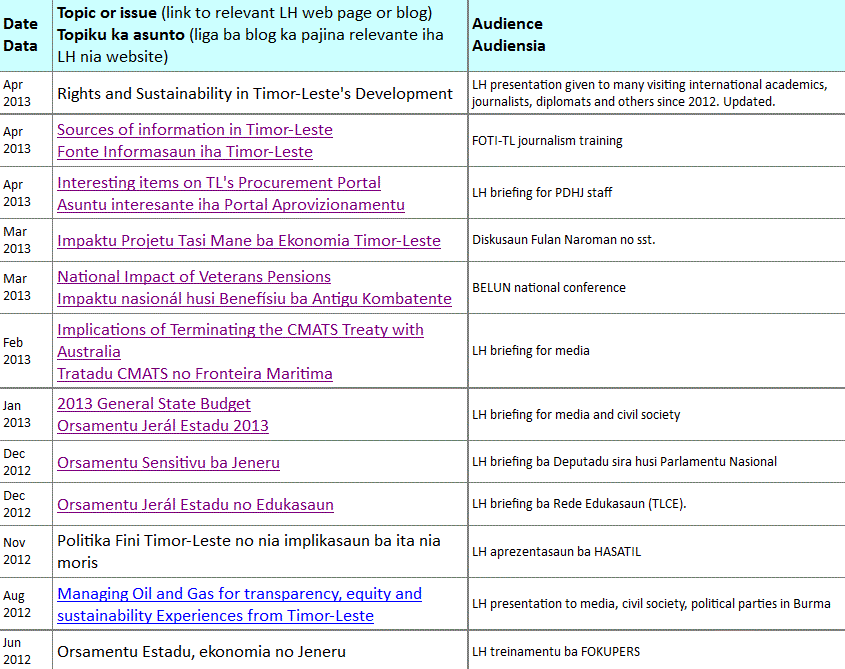
Dezde tinan kotuk ne’e, La’o Hamutuk fó ona treinamentu no aprezentasaun sanulu resin ba grupu no instituisaun lubuk kona-ba OJE no ekonomia Timor-Leste, fronteira maritima ho Australia, projetu Tasi Mane, Orsamentu Responsivu ba Jéneru, Portal Transparénsia, Transparénsia, pensaun Veteranu, polítika fini no tópiku sira seluk. Ami mós foin atualiza ami nia aprezentasaun kona-ba Rights and Sustainability in Timor-Leste’s Development (Ingles). Versaun Tetun sei mai.

Ho hanoin atu halo material ne’e bele asesu hosi ema barak, ami publika aprezentasaun sira ne’e iha ami nia pájina foun iha ami nia website – PowerPoint no PDF, Ingles no Tetun. Bele download no uza ba. Karik ita boot hakarak peskizadór La’o Hamutuk nian ida bele fó treinamentu ruma, ka aprezenta ba grupu ka eventu ruma, bele kontaktu ami iha info@laohamutuk.org ka +670-3321040.

Information is power - decentralize it

La'o Hamutuk has just published a new edition of our Reference DVD-ROM (also Tetum) with 4 gigabytes of information from our website and blog, downloads of key government websites, and many reports about Timor-Leste, the region and the world.

Most of this material is available on the web, including on La'o Hamutuk's site. However, internet access in Timor-Leste is among the scarcest and most expensive in the world, so we're making it available in this format for people without easy access to internet.

The DVD was updated for a training we gave to journalists on Sources of Information (also Tetum), organized by FOTI-Timor-Leste.  This training describes a wide variety of information available on Timor-Leste from Government and other sources.

During the past year, La'o Hamutuk has given more than a dozen trainings and presentations to a wide range of groups and institutions on Timor-Leste's budget and economy, maritime boundaries with Australia, the Tasi Mane project, Gender-responsive Budgeting, the Procurement Portal, Transparency, Veterans' pensions, seed policy and other topics.  We just updated our flagship presentation Rights and Sustainability in Timor-Leste's Development. (A Tetum version is forthcoming.)

In order to make this material available to more people, we link to the presentations from a new page on our website -- PowerPoint and PDF files, English and Tetum. Please download and use them. If you would like a La'o Hamutuk researcher to present to a training, group or event, contact us at info@laohamutuk.org or +670-3321040.

08 April 2013

TL slightly improves in UNDP Human Development Index

For more information, including detailed explanations, links and tables, see La'o Hamutuk's web page on this report, no mos iha Tetum.

Since 1990, the United Nations Development Program (UNDP) has issued its Human Development Report almost every year. The edition published on 14 March 2013 is entitled The Rise of the South: Human Progress in a Diverse World, and includes important trends and examples of developing countries in the South improving the lives of their people. In addition to the thematic discussion and a wealth of statistical data on health, education, gender, economics and other aspects of human society, the UNDP calculates a “Human Development Index” (HDI) for each country. The HDI combines life expectancy, education (years of school enrollment) and income (Gross National  Income/GNI per capita) to produce a composite measure of human development.

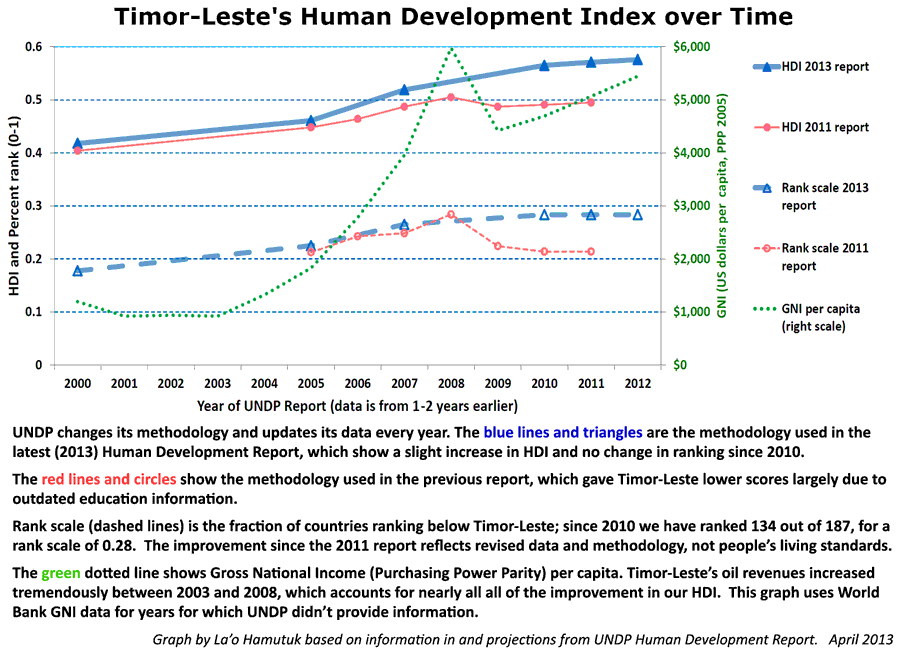
The new report, based mainly on data from 2011, calculates a 2012 HDI for Timor-Leste of 0.576. UNDP categorizes Timor-Leste in the "medium human development group," ranking 134th of 187 countries with data. See UNDP's Timor-Leste-specific press release, statistical summary and explanatory note which provides detail for the general discussion in the previous paragraph. We also posted UNDP's global data spreadsheet (slightly enhanced by La'o Hamutuk). It is a gold mine with data on hundreds of indicators for nearly 200 countries and territories.

Although Timor-Leste moved up 13 rank positions compared with last year's 2011 report, UNDP cautions not to compare reports published at different times. Using a revised methodology and updated data for prior years, UNDP recalculated Timor-Leste's 2011 HDI to be 0.571, and our 2010 HDI is now 0.565. Timor-Leste's ranking did not change; we ranked 134 out of 187 countries in 2010, 2011 and 2012. LUSA and other media reported this incorrectly, but UNDP had explained it clearly.

The slight HDI improvement over the last two years is largely because GNI (gross national income per capita, adjusted for inflation) increased from $4,700 to $5,400 between 2010 and 2012, and because people are living a little longer. Three-fourths of our GNI is petroleum revenues, which do not go directly to Timorese individuals. The larger HDI gains since 2000 and 2005 reflect that oil revenues were zero in 2000 and have increased five-fold since 2005, as the green dotted line on the graph above shows.

UNDP also calculates a Multi-Dimensional Poverty Index (MPI) for each country, representing the percentage of people living in households where at least one person is deprived of education, health or standard of living. Based on data from the 2009/2010 Demographic and Health Survey, UNDP calculated that 68.1% of Timor-Leste's people live in multidimensional poverty, with an additional 18.2% "vulnerable to multiple deprivations." In other words, six out of every seven Timor-Leste citizens face major obstacles to improving their lives, which creates a huge challenge for Government, international agencies, civil society organizations and our people.

Some local media inaccurately reported that UNDP had said that 68.1% of Timor-Leste's people live below the poverty line. These press reports angered the Minister of Finance, who abruptly cancelled two meetings with UN agencies.

UNDP recognizes that income is not the best measure of human development, so they also calculate a non-income HDI based only on health and education, which was .569 for Timor-Leste in 2012. When ranked in comparison with other countries, Timor-Leste ranks 29 places better on income than our HDI ranking, meaning that our people have lower human development than other countries with the same cash income.

The Human Development Report also measures how much inequality there is in each country, and Timor-Leste's inequality-adjusted Human Development Index is .386, 33% lower than our HDI when inequality is not considered. Because many other impoverished countries are also very unequal, our ranking only drops three places when inequality is considered.

Our web page includes a table with data for Timor-Leste and a few other countries from the 2013 Human Development Report, as well as links to additional data from UNDP.

02 April 2013

Timor-Leste people tell U.S. to close Guantanamo prison

During the last few weeks, people all over the world have been asking the United States Government to close the illegal prison it operates on a U.S. military base in Guantanamo, Cuba. Although many detainees have been released, the U.S. still imprisons 166 human beings -- all men, all Muslim -- in Guantanamo, many for more than eleven years. None of them has been convicted in a judicial process, and their imprisonment violates U.S. and international law, as well as the fundamental principle of "innocent until proven guilty."

For more than fifty days, more than 100 of the prisoners have been on hunger strike. Many human rights activists are fasting in solidarity with them. Although starving themselves may be the only way the prisoners still have to express themselves, people outside Guantanamo's cells also have other means.

English
Tetum
In Timor-Leste, about 30 people wrote a letter to President Barack Obama to appeal that the prison be closed immediately, its inmates released and compensated for the severe violations to their human rights. They also demanded that people who committed crimes related to their illegal arrest, imprisonment and torture at Guantanamo be brought to justice.

They also wrote to Timor-Leste President Taur Matan Ruak and other public officials in Tetum, at right. This letter asks the Head of State to ask the United States, in Timor-Leste's name, to free all Guantanamo prisoners, close the prison because it violates human rights principles, and compensate the victims and ask their countries to welcome them back. Based on Timor-Leste's history, and its ratification of international human rights conventions, the signers hope that President Taur Matan Ruak will represent Timor-Leste's people's request to show solidarity with the Guantanamo prisoners.

When signers of the letter to President Obama delivered it to the U.S. embassy, the embassy respected their freedom of expression and an embassy official graciously accepted the letter and will forward it to the White House. Organizers had spoken with Ambassador Judith Fergin in advance, and she asked Timor-Leste's police to allow the peaceful protest, notwithstanding Timor-Leste's law which bans protests within 100 meters of government and embassy facilities.
Atauro Island, across the sea behind the demonstrators, was used by Portuguese and Indonesian occupiers of Timor-Leste as a political detention center.  Indonesia sent more than 6,000 Timorese people there, where they were often held for many years without charges, just as in Guantanamo. Today, everyone in Atauro is free, and the island is a farming/fishing community and an ecotourism resort.