Maski governu tarde loron sanulu atu aprezenta nia Proposta Orsamentu Jeral Estadu 2014 ba Parlamentu Nasionál, sira hakarak Parlamentu sei aprova orsamentu ne’e molok loron Natal no Deputada/u sira hahú ona audiensia “públiku.” Bele asesu oráriu ba audiensia públiku iha ne’e.
Iha mudansa pozitivu katak Ministériu Finansas publika versaun eletróniku ba livru OJE neen iha sira nia pájina web iha loron 25 Outubru, loron hanesan sira mós haruka orsamentu ne’e ba Parlamentu Nasionál. Loron ida antes Ministériu ne’e mós publika sira nia aprezentasaun no matéria seluk iha semináriu Parlamentár. Dokumentu sira ne’e, ho análize kle’an iha Ingles no Tetum, iha La’o Hamutuk nia pájina web kona ba OJE 2014 ne’ebé sempre atualiza.
Ami apresia ho envelope fiskál tomak ne’ebé hatún hosi billaun $1.65 iha OJE 2013 ba billaun $1.5 iha proposta orsamentu agora. Boot liu hamenus hosi alokasaun orsamentu ba projetu infrastrutura boot ne’ebé dala ruma labele implementa tuir tempu. Maibé alokasaun rekurente kontinua sa’e, no ezekusaun gastu durante tinan 2013 sei atinje dala ruma menus hosi billaun $1.2, nune’e proposta OJE 2014 sei aumenta despeza 25%. La hanesan ho tinan 2013, iha OJE 2014 nafatin foti liu Rendimentu Sustentavel Estimativa (RSE/ESI) hosi Fundu Petrólifeiru, tokon $903 (tokon $632 iha RSE). Espetasaun ba reseita petrólifeiru iha futuru sei tun liu tanba produsaun no mós presu estimadu sei menus, kampu Bayu-Undan no Kitan sei maran molok tinan 2020.
La’o Hamutuk kontente atu haree kreximentu alokasaun ba saúde no edukasaun, maibé setór hirak ne’e nafatin ki’ik liu tuir padraun internasionál. No mós setór agrikultura nudár vida moris maioria povu Timor-Leste ladún hetan atensaun maka’as iha Timor-Leste. Maski auto estrada iha Kosta súl hasai ona, maibé parte balu hosi Projetu Tasi Mane ne’ebé sei nafatin hela iha orsamentu.
Infelizmente, Parlamentu sei rona testemuña hosi Organizasaun Naun-Governmentál uitoan liu duke iha tinan pasadu. Maski La’o Hamutuk hetan konvite hosi Parlamentu Nasionál halo aprezentasaun no observa iha audiensia no seminar iha prosesu orsamentál hitu ne’ebé hala’o dezde tinan 2009, tinan ida ne’e sira la konvida ami, maibé ami sei kontinua análiza ba impaktu proposta orsamentu ba Timor-Leste nia futuru. La'o Hamutuk haruka ona karta ba Deputada/u sira. Ami esplika asuntu balun, hanesan karik PN konvida ona ami atu fo submisaun.
Ami espera katak sidadaun no organizasaun sira seluk mós komunika ho Parlamentu Nasionál, no katak debate tuir mai sei bazeia ba faktu, ativu, transparente no hetan rezultadu di’ak.
09 November 2013
05 November 2013
Hearings begin on 2014 budget proposal
Although the Government was ten days late in submitting its proposed 2014 State Budget to Parliament, Parliament still hopes to approve it before Christmas and has begun "public" hearings. Download the hearing schedule here.
In a positive development, the Ministry of Finance posted electronic versions of the six budget books to their website on 25 October, the same day they sent the budget to Parliament. The Ministry also released their presentation (Tetum) to a Parliamentary seminar the previous day. These and other materials, with deeper analyses in English and Tetum, are on La'o Hamutuk's frequently updated web page on the 2014 budget.
We appreciate that the overall fiscal envelope has been reduced from $1.65 billion in the 2013 budget to $1.5b in the proposed one, largely by cutting funding for infrastructure mega-projects which were unlikely to be implemented on schedule. However, recurrent appropriations continue to go up, and executed spending during 2013 will probably be less than $1.2b, so the 2014 proposal still represents a 25% increase. Unlike in 2013, the 2014 budget again spends more than the Estimated Sustainable Income from the Petroleum Fund, $903 million (ESI is $632 million). Expected future oil revenues have dropped markedly due to lower production and price forecasts; the Bayu-Undan and Kitan fields will by exhausted by 2020.
La'o Hamutuk is glad to see increased appropriations for health and education, although they remain below international norms. However, agriculture, the livelihood of most Timorese people, is still under-served. Although the South Coast Highway has been cut, other parts of the questionable Tasi Mane project remain in the budget.
Unfortunately, Parliament will hear from many fewer non-state witnesses than in past years. Although Parliament has invited La'o Hamutuk to present or observe at hearings and seminars for all seven budget processes conducted since 2009, they did not do so this time. Nevertheless, we will continue to analyze the impact of this budget on Timor-Leste's future, and have written to Members of Parliament (Tetum original) explaining some issues we would have discussed if they had invited us to testify.
We encourage others to study the budget proposal and to share their thoughts with Parliament. We hope that the upcoming debate will be fact-based, lively, transparent and productive.
[This post was updated on 11 November 2013.]
In a positive development, the Ministry of Finance posted electronic versions of the six budget books to their website on 25 October, the same day they sent the budget to Parliament. The Ministry also released their presentation (Tetum) to a Parliamentary seminar the previous day. These and other materials, with deeper analyses in English and Tetum, are on La'o Hamutuk's frequently updated web page on the 2014 budget.
We appreciate that the overall fiscal envelope has been reduced from $1.65 billion in the 2013 budget to $1.5b in the proposed one, largely by cutting funding for infrastructure mega-projects which were unlikely to be implemented on schedule. However, recurrent appropriations continue to go up, and executed spending during 2013 will probably be less than $1.2b, so the 2014 proposal still represents a 25% increase. Unlike in 2013, the 2014 budget again spends more than the Estimated Sustainable Income from the Petroleum Fund, $903 million (ESI is $632 million). Expected future oil revenues have dropped markedly due to lower production and price forecasts; the Bayu-Undan and Kitan fields will by exhausted by 2020.
La'o Hamutuk is glad to see increased appropriations for health and education, although they remain below international norms. However, agriculture, the livelihood of most Timorese people, is still under-served. Although the South Coast Highway has been cut, other parts of the questionable Tasi Mane project remain in the budget.
Unfortunately, Parliament will hear from many fewer non-state witnesses than in past years. Although Parliament has invited La'o Hamutuk to present or observe at hearings and seminars for all seven budget processes conducted since 2009, they did not do so this time. Nevertheless, we will continue to analyze the impact of this budget on Timor-Leste's future, and have written to Members of Parliament (Tetum original) explaining some issues we would have discussed if they had invited us to testify.
We encourage others to study the budget proposal and to share their thoughts with Parliament. We hope that the upcoming debate will be fact-based, lively, transparent and productive.
[This post was updated on 11 November 2013.]
Labels:
English
16 October 2013
HASATIL statement for World Food Day
HAMETIN AGRIKULTURA SUSTENTAVEL TIMOR-LOROSAE
This statement is available as PDF in English, Tetum, Portuguese and Bahasa Indonesia.
Today, October 16th, 2013, many nations around the world celebrate World Food Day. Unfortunately, in this world we're living in, a lot of poor people are hungry because they do not have access to food, while at the same time many wealthy people suffer from health conditions due to excessive food consumption or imbalanced food diet. Globally, there is enough food for everyone to consume, but it is unequally distributed.
The official theme of this year’s World Food Day is: “Sustainable Food Systems for Food Security and Nutrition.” This is an opportunity for us to question about:
- Non-sustainable food systems that produce poor quality food with low nutritional values, like the processed industrial products full of preservatives, salt, sugar (e.g. in instant meals) and industry-related pollutants.
- Non-sustainable food systems that damage the environment by using a lot of energy and natural resources to produce industrial food, and causing many forms of pollution like plastics, cans and other materials used for wrappings.
- Non-sustainable food systems that create social injustice as they do not give value to the work of the farmers but instead generate huge benefits for the agro-chimical industries.
- Non-sustainable food systems that have altered our food habits, traditional cooking and culture to eat in season, and have lead us to consume a limited variety of food and to prefer unhealthy instant meals.
- Non-sustainable food systems that promote an industrial agriculture model based on mechanization, the excessive use of pesticides, chemical fertilizers and water, as well as standardized "high yielding" seeds produced by laboratories at the expense of the variety of local seeds that are actually more adaptable. The result is a massive loss of biodiversity.
The message to the farmers:
Thank you for your contribution and the great efforts you make to produce good and healthy food. We should not abandon our local original food crops including the wild ones that saved us during our long struggle for independence. We must promote food diversification in our farms, to improve child nutrition and avoid dependence on a few crop species only.The message to all of us consumers:
We must use our purchasing power to buy products which are healthy, which strengthen the domestic economy through the purchase of local products from small-scale farmers and which are not harmful to the environment. We must give higher value to our local products than to the imported ones and change this mentality consisting in considering eating rice as the only parameter that measures whether one has had his/her meal or not. There is a variety of food products much more nutritious than rice (carbohydrate), such as vegetables, fruits, beans, cassava, meat, fish, etc. We must not eat with the only objective to be full; we must know the nutritional value of the food we eat.Our message to the Timor-Leste Government, which has an important role in guaranteeing that development benefit all Timorese people, of the current and future generations:
Food security must not be viewed from the quantitative aspect only. Every year we import huge amount of foods (especially rice) but our level of malnutrition remains high. We consume much more rice and much less fish than other countries . The Government should address the malnutrition issue from a qualitative aspect, and focus on food diversification and education about nutrition. Priority should be given to the development of the livestock and poultry sectors, fisheries, forestry rehabilitation and protection and rural infrastructure.The Government should take measures to reduce food imports and regulate the import of chemical products that have bad effects both on health and the environment. The productive sector and small-scale sustainable co-operatives should be developed to substitute our economy that is heavily dependent on petroleum revenues.
The Government should promote a sustainable agriculture model that doesn’t depend on expensive inputs, benefit small farmers and contribute to nature enhancement like agro-ecology and permaculture.
At the international level, the UN Special Rapporteur on the Right to Food Sr. Olivier de Schutter has already shown that the future of agriculture is agro-ecology . Thus, we encourage Timor-Leste Government to build a sustainable food system for our nation, to guarantee our food sovereignty.
HASATIL Advocacy Team and Secretariat
- La’o Hamutuk Institute
- HAK Association
- Haburas Foundation
- Fokupers
- Caritas Baucau
- Kdadalak Sulimutuk Insitute (KSI)
- Haburas Moris Organization (OHM-Maliana)
Labels:
English,
Portuguese,
Tetum
14 October 2013
Making the Business Activities Survey even more useful
The RDTL Directorate-General of Statistics (DGS) has published Business Activities Surveys for 2010 and 2011, and the 2012 edition will be released this month. Two weeks ago, DGS invited users of this data to discuss possible changes for the questionnaire for the 2013 Survey, which will be conducted in early 2014. After a lively discussion with MoF, ADB, SEPFOPE, ILO, UNFPA, La'o Hamutuk, the Australian Bureau of Statistics and others, DGS invited written suggestions. The rest of this blog is an abridged version of La'o Hamutuk's submission.
The BAS is essential to a solid understanding of Timor-Leste’s macro- and micro-economy. Enhancing the BAS could provide better information about critical issues here, including:
It would be useful to expand the portion of the economy covered by the BAS to include international agencies, non-profit organizations and public institutions, which are significant portions of Timor-Leste’s employment and economic activity. In addition, a separate survey of the informal sector, which involves more than 2/3 of the working-age population, would be invaluable in understanding how to develop our economy.
The BAS can help confirm or identify discrepancies in other data. Therefore, it is important to collect data independently as much as practical, rather than relying on other sources.
It would be useful to know what percentages of businesses are owned by foreigners and what percentage by Timorese nationals. Can the BAS find out what portion of equity is owned by Timorese entities and by non-Timorese? Since preferential contracting is one of the ways that the Government honors veterans for their service to the nation, it would also be interesting to know how many companies are owned by veterans, how they contribute to various sectors, and if their statistics are significantly different from non-veteran companies.
Some of the "Business Type" categories are too broad and should be disaggregated.
Are people who do unpaid labor (due to family obligations or in exchange for housing, tuition, a commission, etc.) considered as employees? They are a large part of Timor-Leste’s labour force.
At present, Timor-Leste’s non-petroleum export sector is very small, according to Trade Statistics reports (although we worry that some exports may not be counted in these reports). It would be interesting to ask what portion of sales of goods is to customers outside Timor-Leste or who intend to sell the goods overseas. Since expanding TL’s exports is often mentioned as a goal for economic development, this would provide a baseline from which it could be measured, expanding and/or cross-checking the Trade Statistics.
Approximately half of Timor-Leste’s “non-oil” economy is fuelled by public spending (90% of which comes from oil money). It would be useful to know, for each business, how much of their income comes from:
It would be good to ask if goods and materials purchased for capital investment came from Timor-Leste or from overseas.The current questions are not clear, and perhaps a category should be added to cover purchases of imported assets from a local supplier.
Suggestions for revisions to the Business Activities Survey
La’o Hamutuk, as a Timor-Leste civil society organization which tries to understand Timor-Leste’s economy and encourage sustainable, equitable development, is grateful for the invitation from the Directorate-General for Statistics to join the discussion about the Business Activities Survey (BAS). As you know, we often use DGS research and publications, including the BAS, and find them very valuable.The BAS is essential to a solid understanding of Timor-Leste’s macro- and micro-economy. Enhancing the BAS could provide better information about critical issues here, including:
- Import dependency (we have a 95% trade deficit)
- The effect of public spending (which underlies about half our non-oil GDP)
- The all-important productive, non-oil, non-state-funded, private sector (which is currently very small but needs to grow rapidly)
- How much of Timor-Leste’s wealth stays in the country? (Most of the revenue from our declining petroleum reserves goes out of Timor-Leste.)
It would be useful to expand the portion of the economy covered by the BAS to include international agencies, non-profit organizations and public institutions, which are significant portions of Timor-Leste’s employment and economic activity. In addition, a separate survey of the informal sector, which involves more than 2/3 of the working-age population, would be invaluable in understanding how to develop our economy.
The BAS can help confirm or identify discrepancies in other data. Therefore, it is important to collect data independently as much as practical, rather than relying on other sources.
It would be useful to know what percentages of businesses are owned by foreigners and what percentage by Timorese nationals. Can the BAS find out what portion of equity is owned by Timorese entities and by non-Timorese? Since preferential contracting is one of the ways that the Government honors veterans for their service to the nation, it would also be interesting to know how many companies are owned by veterans, how they contribute to various sectors, and if their statistics are significantly different from non-veteran companies.
Some of the "Business Type" categories are too broad and should be disaggregated.
Are people who do unpaid labor (due to family obligations or in exchange for housing, tuition, a commission, etc.) considered as employees? They are a large part of Timor-Leste’s labour force.
At present, Timor-Leste’s non-petroleum export sector is very small, according to Trade Statistics reports (although we worry that some exports may not be counted in these reports). It would be interesting to ask what portion of sales of goods is to customers outside Timor-Leste or who intend to sell the goods overseas. Since expanding TL’s exports is often mentioned as a goal for economic development, this would provide a baseline from which it could be measured, expanding and/or cross-checking the Trade Statistics.
Approximately half of Timor-Leste’s “non-oil” economy is fuelled by public spending (90% of which comes from oil money). It would be useful to know, for each business, how much of their income comes from:
- RDTL Government contracts or purchases
- Other companies implementing RDTL Government contracts (to identify subcontractors)
- How much was imported directly by the business?
- How much was produced overseas but purchased from a local importer or other business?
It would be good to ask if goods and materials purchased for capital investment came from Timor-Leste or from overseas.The current questions are not clear, and perhaps a category should be added to cover purchases of imported assets from a local supplier.
Labels:
English
09 October 2013
LH protests contract award to CNI22
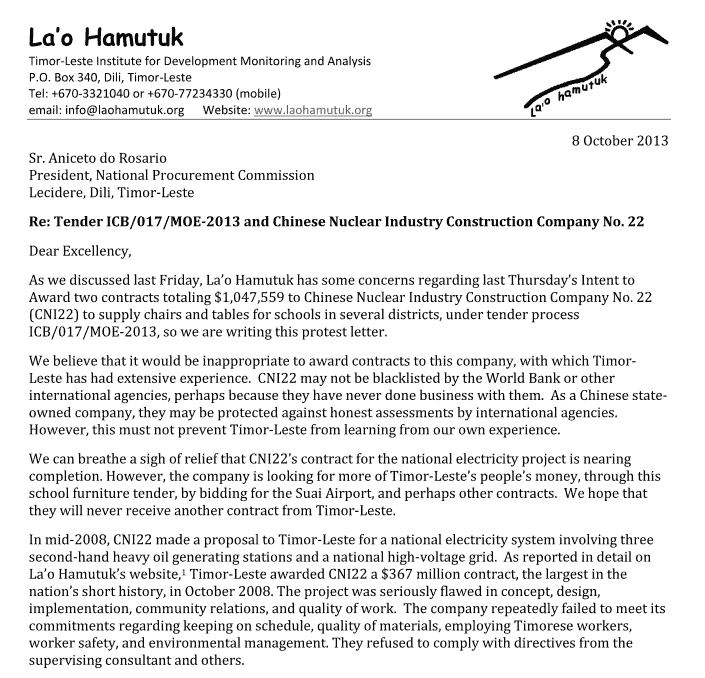
Last week, Timor-Leste newspapers published an Intent to Award nearly three million dollars in contracts for school furniture. La'o Hamutuk was astonished to see that more than $1 million will go to Chinese Nuclear Industry Construction Company No. 22, which had performed atrociously after it got a $300 million contract in 2008 to build Timor-Leste's power plants and national electricity grid.
We met with the Chair of the National Procurement Commission to express our concerns and wrote a formal protest letter (Tetum translation). The rest of this blog is adapted from our 8 October letter to President Aniceto do Rosario of the National Procurement Commission.
Dear Excellency,
As we discussed last Friday, La’o Hamutuk has concerns regarding the Intent to Award two contracts totaling $1,047,559 to Chinese Nuclear Industry Construction Company No. 22 (CNI22) to supply school chairs and tables.
We believe that it would be inappropriate to award contracts to this company, with which Timor-Leste has had extensive experience. CNI22 may not be blacklisted by the World Bank or other international agencies, perhaps because they have never done business with them. As a Chinese state-owned company, they may be protected against honest assessments by international agencies. However, this must not prevent Timor-Leste from learning from our own experience.
We are relieved that CNI22’s contract for the national electricity project is nearing completion. However, the company is looking for more of Timor-Leste’s money through this school furniture tender, the Suai Airport, and perhaps other contracts. We hope that they will never receive another contract from Timor-Leste.
In mid-2008, CNI22 proposed to Timor-Leste to build a national electricity system involving three second-hand heavy oil generating stations and a national high-voltage grid. As reported in detail on La’o Hamutuk’s website and in our Bulletin, Timor-Leste awarded CNI22 a $367 million contract, the largest in the nation’s history, in October 2008. The project was seriously flawed in concept, design, implementation, community relations, and quality of work. The company repeatedly failed to meet its commitments regarding keeping on schedule, quality of materials, employing Timorese workers, worker safety, and environmental management. They refused to comply with directives from the supervising consultant and others.
After two years, when CNI22 had shown that it was incapable of building the power plants it had proposed, they were re-contracted to Puri Akraya Engineering, increasing the cost by hundreds of millions of dollars and delaying the project for several years.
You don’t have to take La’o Hamutuk’s word for this. For the last four years, Timor-Leste has hired ELC/Bonifica to supervise the power project construction. Their monthly reports describe CNI22’s “overall performance” as “poor” nearly every month. Last week, at a seminar in the Ministry of Public Works on this project, ELC Project Manager Massimiliano de Carli reiterated several times that: “The most important element in implementing any project is selecting the right contractor, appreciating their proved experience, skills and capabilities.” It is obvious to people with detailed knowledge of CNI22’s work on the electricity project that CNI22 should not have been selected, and we are puzzled that Timor-Leste wants to give them more business.
Outside observers were also aware early on. In December 2008, U.S. ambassador Hans Klemm sent a "sensitive" internal cable from Dili to Washington. Wikileaks later published the "for official use only" cable without authorization. It says:
CNI22 will import furniture from China, sending our people’s money outside the country. Their record gives ample reason not to trust the quality or timeliness of their promises.
Many large tenders here require skills, resources or experience that Timor-Leste companies do not yet possess, making it even more important to ensure that tenders which do not have such complex requirements, like this one, will use locally-made products rather than those imported from afar.
We encourage the National Procurement Commission not to award this or any other contract to Chinese Nuclear Industry Construction Company No. 22, and to develop a system of blacklisting companies which have shown bad faith, incompetence or other inability to meet their commitments.
La'o Hamutuk hopes that everyone who wants Timor-Leste's finite petroleum wealth to be used appropriately will pay close attention to procurement processes announced in the newspapers and the Ministry of Finance website and recently reopened Procurement Portal. Transparency is only useful if people are watching!
P.S. Al Jazeera later reported this story, based on La'o Hamutuk's information.
We met with the Chair of the National Procurement Commission to express our concerns and wrote a formal protest letter (Tetum translation). The rest of this blog is adapted from our 8 October letter to President Aniceto do Rosario of the National Procurement Commission.
Dear Excellency,
As we discussed last Friday, La’o Hamutuk has concerns regarding the Intent to Award two contracts totaling $1,047,559 to Chinese Nuclear Industry Construction Company No. 22 (CNI22) to supply school chairs and tables.
We believe that it would be inappropriate to award contracts to this company, with which Timor-Leste has had extensive experience. CNI22 may not be blacklisted by the World Bank or other international agencies, perhaps because they have never done business with them. As a Chinese state-owned company, they may be protected against honest assessments by international agencies. However, this must not prevent Timor-Leste from learning from our own experience.
We are relieved that CNI22’s contract for the national electricity project is nearing completion. However, the company is looking for more of Timor-Leste’s money through this school furniture tender, the Suai Airport, and perhaps other contracts. We hope that they will never receive another contract from Timor-Leste.
In mid-2008, CNI22 proposed to Timor-Leste to build a national electricity system involving three second-hand heavy oil generating stations and a national high-voltage grid. As reported in detail on La’o Hamutuk’s website and in our Bulletin, Timor-Leste awarded CNI22 a $367 million contract, the largest in the nation’s history, in October 2008. The project was seriously flawed in concept, design, implementation, community relations, and quality of work. The company repeatedly failed to meet its commitments regarding keeping on schedule, quality of materials, employing Timorese workers, worker safety, and environmental management. They refused to comply with directives from the supervising consultant and others.
After two years, when CNI22 had shown that it was incapable of building the power plants it had proposed, they were re-contracted to Puri Akraya Engineering, increasing the cost by hundreds of millions of dollars and delaying the project for several years.You don’t have to take La’o Hamutuk’s word for this. For the last four years, Timor-Leste has hired ELC/Bonifica to supervise the power project construction. Their monthly reports describe CNI22’s “overall performance” as “poor” nearly every month. Last week, at a seminar in the Ministry of Public Works on this project, ELC Project Manager Massimiliano de Carli reiterated several times that: “The most important element in implementing any project is selecting the right contractor, appreciating their proved experience, skills and capabilities.” It is obvious to people with detailed knowledge of CNI22’s work on the electricity project that CNI22 should not have been selected, and we are puzzled that Timor-Leste wants to give them more business.
Outside observers were also aware early on. In December 2008, U.S. ambassador Hans Klemm sent a "sensitive" internal cable from Dili to Washington. Wikileaks later published the "for official use only" cable without authorization. It says:
In July 2008, news surfaced that the government would purchase two large electricity generating plants from a Chinese firm that would also be contracted to put into place a nationwide transmission grid. On this occasion, the government issued an international tender, although the widespread understanding in Dili was that the purchase had been agreed before the government announced the tender. Although observers described the tender announcement as insubstantial and technically inadequate, fourteen international firms submitted bids. The decision to award the contract to the Chinese firm again was made by the prime minister with very little consultation with line ministers. The power plants are old equipment (with some 40 years of service in China already behind them) that will be dissembled, exported and refitted in Timor-Leste. They will burn heavy oil that Timor will have to import. Experts describe the contracted installation of a national transmission grid within two years as a fantasy. The World Bank reportedly has urged the government to cancel the contract, absorb the penalty, and re-tender the project.We also wonder what CNI22 knows about school furniture. The company’s description gives no indication that they work in this area:
During the past 50 years, CNI22 has completed more than 2000 construction and installation works, and the total construction area was over 2 million m2. Our company has undertaken a large number of construction works of power plants, factories, housing, airports, bridges, roads etc, and for the good quality of our projects and technology innovation, CNI22 is awarded more than 80 national and provincial and municipal prizes, including the construction engineering “Luban Prize”. CNI22 have offices in 39 countries, and we still have Projects under construction in Algeria, Sudan, Pakistan, Mongolia, Vietnam and East Timor. In the field of civil engineering, Our company possesses 8 grade-1 qualifications, including housing construction, electrical engineering, mechanical and electrical installation works, steel works, the installation of lifting equipment, blasting and demolition engineering and nuclear engineering and so on.Finally, we encourage the National Procurement Commission to consider how contract awards can help Timor-Leste businesses grow, creating employment and keeping more of our national wealth in this country. Many Timorese companies can make chairs and desks appropriate for our schools, and this tender is a valuable opportunity to help them develop. Thirteen years ago, La’o Hamutuk and others raised this issue with the World Bank and AusAID, and the agencies made changes in procurement of school furniture to enable local companies to participate. Today, in this sovereign nation spending our own money, we should not throw away this opportunity.
CNI22 will import furniture from China, sending our people’s money outside the country. Their record gives ample reason not to trust the quality or timeliness of their promises.
Many large tenders here require skills, resources or experience that Timor-Leste companies do not yet possess, making it even more important to ensure that tenders which do not have such complex requirements, like this one, will use locally-made products rather than those imported from afar.
We encourage the National Procurement Commission not to award this or any other contract to Chinese Nuclear Industry Construction Company No. 22, and to develop a system of blacklisting companies which have shown bad faith, incompetence or other inability to meet their commitments.
La'o Hamutuk hopes that everyone who wants Timor-Leste's finite petroleum wealth to be used appropriately will pay close attention to procurement processes announced in the newspapers and the Ministry of Finance website and recently reopened Procurement Portal. Transparency is only useful if people are watching!
P.S. Al Jazeera later reported this story, based on La'o Hamutuk's information.
Labels:
English
14 September 2013
Konsultasaun ba proposta Kódigu Mineiru hahú ona
Informasaun foun, Junu 2014: MPRM hatete ba La'o Hamutuk katak sira muda ona sira nia planu, no sei LAIHA konsultasaun publiku iha Dili kona-ba ezbosu lei ida ne'e. Sira hanoin atu haruk nia ba Konsellu Ministru iha tempo badak.
Ministériu Petróleu no Rekursu Minerais ko’alia ona ho ema barak iha nasaun ida ne’e kona ba ezbosu Lei Mineiru ba lisensiamentu no regulamentu operasionál minerais nian iha nasaun ne’e. Konsultasaun primeiru iha Oekusi hahú iha 26 Agosto, no konsultasaun tuir mai sei hala’o iha Suai iha 25 Setembru. La’o Hamutuk sírkula ezbosu lei ne’e no liu husi pájina ne’e ami enkoraja ita boot sira atu estuda no fó sujestaun.
Operasaun mineiru kria problema barak ba ema iha mundu tomak. Maski sei fó rendimentu ba governu no kompañia transnasional sira, atividade operasaun ne’e dala barak hamosu destruisaun ambientál, kria problema hanesan eviksaun; poluisaun rai, bee no atmosfera; violasaun direitus umanus; konflitu; funu no harahun buat barak ba ema hirak ne’ebé hela besik ka iha area atividade operasaun minerais.
Esperiénsia hatudu katak regulasaun ne’ebé efetivu sai esensiál (maski dala barak la sufisiente), atu redús devastasaun no proteje povu nia direitu. Haree ba realidade katak atividade minerais la'os sustentavel (ho gastu rikusoin minerais naun renovavel hodi hetan osan), ne’e sempre iha dezafiu boot atu minimiza impaktu negativu. Ami espera katak konsultasaun públiku ne’ebé efetivu - no mós ho boa vontade hosi governu no Parlamentu hodi rona - sei ajuda implementa lei ne’ebé sei proteje ita nia povu nia interese ba tempu badak no mós tempu naruk.
La’o Hamutuk halo scan ezbosu lei ne’ebé inklui artigu 178 iha ezbosu Kódigu Mineiru, ne’ebé ita bele download iha Ingles hanesan PDF ka dokumentu Word. MPRM mós fasilita versaun Tetun no Portugés.
Ministériu Petróleu no Rekursu Minerais seidauk husu atu hakerek submisaun, maibé ami espera katak sira sei konsidera hanoin balu hosi ema matenek na’in sira, espesialmente ba ema ne’ebé iha esperiénsia ba operasaun mineira nian. Labele ignora atividade operasaun ne’e tanba nia risku boot liu hanesan lisaun ne’ebé hatudu iha nasaun hotu. La’o Hamutuk husu komentáriu no sujestaun atu aumenta ami nia submisaun ne’ebé ami sei hakerek (favor bele haruka ba laohamutuk@gmail.com), no ami enkoraja ba públiku no organizasaun sira atu haruka sira nia komentáriu ba Ministru Alfredo Pires. La’o Hamutuk kontente atu publika iha ami nia pájina web kualkér submisaun ka análize ne’ebé ita boot sira fahe ba ami.
Ministériu Petróleu no Rekursu Minerais ko’alia ona ho ema barak iha nasaun ida ne’e kona ba ezbosu Lei Mineiru ba lisensiamentu no regulamentu operasionál minerais nian iha nasaun ne’e. Konsultasaun primeiru iha Oekusi hahú iha 26 Agosto, no konsultasaun tuir mai sei hala’o iha Suai iha 25 Setembru. La’o Hamutuk sírkula ezbosu lei ne’e no liu husi pájina ne’e ami enkoraja ita boot sira atu estuda no fó sujestaun.
Operasaun mineiru kria problema barak ba ema iha mundu tomak. Maski sei fó rendimentu ba governu no kompañia transnasional sira, atividade operasaun ne’e dala barak hamosu destruisaun ambientál, kria problema hanesan eviksaun; poluisaun rai, bee no atmosfera; violasaun direitus umanus; konflitu; funu no harahun buat barak ba ema hirak ne’ebé hela besik ka iha area atividade operasaun minerais.
![]() |
| Iha Novembru 2008, Sekretáriu Estadu Rekursu Naturais estabelese Asosiasaun Lia Na’in ne’ebé simbolikamente fó direitu esplorasaun mineira nian ba Primeiru Ministru Xanana Gusmão. |
La’o Hamutuk halo scan ezbosu lei ne’ebé inklui artigu 178 iha ezbosu Kódigu Mineiru, ne’ebé ita bele download iha Ingles hanesan PDF ka dokumentu Word. MPRM mós fasilita versaun Tetun no Portugés.
Ministériu Petróleu no Rekursu Minerais seidauk husu atu hakerek submisaun, maibé ami espera katak sira sei konsidera hanoin balu hosi ema matenek na’in sira, espesialmente ba ema ne’ebé iha esperiénsia ba operasaun mineira nian. Labele ignora atividade operasaun ne’e tanba nia risku boot liu hanesan lisaun ne’ebé hatudu iha nasaun hotu. La’o Hamutuk husu komentáriu no sujestaun atu aumenta ami nia submisaun ne’ebé ami sei hakerek (favor bele haruka ba laohamutuk@gmail.com), no ami enkoraja ba públiku no organizasaun sira atu haruka sira nia komentáriu ba Ministru Alfredo Pires. La’o Hamutuk kontente atu publika iha ami nia pájina web kualkér submisaun ka análize ne’ebé ita boot sira fahe ba ami.
Labels:
Tetum
08 September 2013
Draft Mining Law consultation starts
Lee blog ida ne'e iha Tetum.
Update, June 2014: MPRM told La'o Hamutuk that they have changed their plans, and there will NOT be any public consultation on this law in Dili. They expect to send it to the Council of Ministers soon.
Timor-Leste's Ministry of Petroleum and Mineral Resources (MPRM) has been talking with people around the country about a proposed law and code to license and regulate mining operations in the country. The first consultation was in Oecusse on 26 August, and another will take place in Suai on 25 September. La'o Hamutuk is circulating the draft law through this posting, and we encourage people to study it and offer suggestions.
Mining operations create problems for people all over the world. Although they may provide income for governments and transnational companies, they often result in environmental destruction; displacement; pollution of land, air and water; human rights violations; conflict; war and other devastating consequences for people living near or downstream from the mines.
Experience shows that effective regulation is essential (although not always sufficient) to reduce damage and protect people's rights. Given the intrinsic non-sustainability of mining activities (which use up non-renewable mineral resources in order to provide cash), it is always challenging to minimize their negative impacts. We hope that effective public consultation -- together with the willingness of the Government and Parliament to listen -- can help Timor-Leste enact legislation which will protect our people's short- and long-term interests.
La'o Hamutuk scanned the English translation of the draft law and associated 178-article draft Mining Code, which you can download as a PDF or Word file. MPRM has also provided Portuguese and Tetum versions.
MPRM has not yet asked for written submissions, and we hope that they will consider input from knowledgeable people, especially those who have experience with mining operations. The risks are too high to ignore lessons already learned all over the world. La'o Hamutuk welcomes comments and suggestions to improve the submission we will write (please send them to laohamutuk@gmail.com), and we encourage people and organizations to send their own comments to Minister Alfredo Pires. La'o Hamutuk is happy to web-publish any submissions and analyses which are shared with us.
Update, June 2014: MPRM told La'o Hamutuk that they have changed their plans, and there will NOT be any public consultation on this law in Dili. They expect to send it to the Council of Ministers soon.
Timor-Leste's Ministry of Petroleum and Mineral Resources (MPRM) has been talking with people around the country about a proposed law and code to license and regulate mining operations in the country. The first consultation was in Oecusse on 26 August, and another will take place in Suai on 25 September. La'o Hamutuk is circulating the draft law through this posting, and we encourage people to study it and offer suggestions.
Mining operations create problems for people all over the world. Although they may provide income for governments and transnational companies, they often result in environmental destruction; displacement; pollution of land, air and water; human rights violations; conflict; war and other devastating consequences for people living near or downstream from the mines.
Experience shows that effective regulation is essential (although not always sufficient) to reduce damage and protect people's rights. Given the intrinsic non-sustainability of mining activities (which use up non-renewable mineral resources in order to provide cash), it is always challenging to minimize their negative impacts. We hope that effective public consultation -- together with the willingness of the Government and Parliament to listen -- can help Timor-Leste enact legislation which will protect our people's short- and long-term interests.
MPRM has not yet asked for written submissions, and we hope that they will consider input from knowledgeable people, especially those who have experience with mining operations. The risks are too high to ignore lessons already learned all over the world. La'o Hamutuk welcomes comments and suggestions to improve the submission we will write (please send them to laohamutuk@gmail.com), and we encourage people and organizations to send their own comments to Minister Alfredo Pires. La'o Hamutuk is happy to web-publish any submissions and analyses which are shared with us.
Labels:
English
Subscribe to:
Comments (Atom)